New York Times: Hunter Defends His Union Record
Billy Hunter of the NBA players union speaks out for the first time since an investigation exposed nepotism and other unsavory practices.
What’s happening with Hostess Brands is a microcosm of what’s wrong with America, as Bain-style Wall Street vultures make themselves rich by making America poor. Crony capitalism and consistently poor management drove Hostess into the ground, but its workers are paying the price. These workers, who consistently make great products Americans love and have offered multiple concessions, want their company to succeed. They have bravely taken a stand against the corporate race-to-the-bottom. And now they and their communities are suffering the tragedy of a needless layoff. This is wrong. It has to stop. It’s wrecking America.
This isn’t an argument: it’s a recycled talking point. Blaming the free market for every problem that befalls labor is how unions got into this mess (and will never get out of it). Hostess faced a difficult reality: restructure or cease to exist. Labor costs are a major part of the equation, and because the Bakery, Confectionery, Tobacco Workers and Grain Millers International Union (BCTGM) represents the company’s second-largest group of employees, Hostess needs its cooperation. The largest union, the Teamsters, obliged, and even asked the BCTGM to back down from the destructive strike. But BCGTM stayed on the picket lines through yesterday’s deadline, and Hostess announced this morning that it had to liquidate the company.
What the BCTGM did might be “brave” as Trumka claims, but it isn’t smart. And if you don’t think so, consider labor’s response: trashing an unrelated venture capital firm that used to be run by a guy who just lost the presidential election.
But don’t blame Trumka for having nothing constructive to say: there is no good argument for the bakers union strike.
Although labor hasn’t officially asked for “payback” this time around, it’s clear that unions intend to be heard on where they stand on the so-called “fiscal cliff.” Labor and its supporters have long fancied themselves as the keepers of the working people, and it appears that unions will take up that mantle again in the coming weeks.
Labor leaders and progressive activists met with President Barack Obama on Tuesday for an hour to discuss what they want to see in the end-of-year budget deal in Congress. While Republicans and the Chamber of Commerce talk about compromises that they are willing to make, labor is pushing President Obama to draw a line in the sand.
It was certainly labor’s big day in the spotlight, and one can only imagine how much the AFL-CIO’s Richard Trumka loved the attention he got from a gaggle of reporters hanging on his every word. One report said that Obama was in “listening mode” while some of his largest financial and philosophical supporters laid out their demands. Chief among those are keeping entitlement benefits static and raising taxes on the rich. And Trumka plainly stated that he would oppose any increase to the Medicare eligibility age, and that no progress had been made on that front.
The ink is barely dry on the I.O.U. from Obama to labor, but it looks like it might be time to start paying. At least one expert has said that Obama “owes them big time.” And Larry Hanley of the Amalgamated Transit Union said last week that “Barack Obama has owed a debt to labor and will continue to owe a debt to labor.” Trumka’s tone indicates that Obama’s debt to him might be bigger than the national debt.
By this morning, it appeared that Obama would be coming in hard on the “cliff” negotiations: he’s proposing double the amount of revenue generation than he proposed in last year’s drawn-out budget battle. He’s slated to meet with business leaders today, but it looks like he already reached some conclusions yesterday after just hearing from labor and liberal activists at the Center for American Progress and MoveOn.org. It’s a sign that Obama’s tone has rapidly changed from his election night victory speech, when he talked about greater cooperation in Washington.
After falling short in pushing through EFCA in his first term, perhaps Obama meant that he would better cooperate with labor to deliver what it wants.
Take a step into an alternate universe, just for a minute: Mitt Romney has just been elected the 45th President of the United States. Millions have been spent on the campaign, but one of the largest chunks comes from Corporation X. This large corporation starts to take claim for Romney’s win even before polls have closed. The leadership of the corporation has made campaign stops to rally its troops throughout the campaign. In press releases that go out hours after Romney’s victory speech, Corp X explains how its many volunteers, phone calls, and door-to-door stops led to the Romney win.
But some people want to know why Corp. X spent so much money on Romney’s campaign. The chairman of Corp. X tells a national newspaper who asks about political spending, “We’re the big dog, but we don’t like to brag.” When asked about what he expects in return for the corporation’s investment, the chairman explains that President-elect Romney needs to deliver on a piece of legislation that favors the corporation. That will be Romney’s payback to Corp. X. The chairman said that Corp. X spent a fortune on electing Romney, and he’s proud of it. And in no uncertain terms, he tells the press that, “Romney has owed a debt to Corp. X and will continue to owe a debt to Corp. X.”
It would only be a matter of time before outrage would ensue from both sides of the aisle.
Now, come back to reality and consider President Obama’s election and re-election. Labor unions spent millions upon millions of dollars to push Obama over the top in 2008 and again in 2012. And what did we hear last time? Here’s a hint: The political activity of imaginary Corp. X and the quotes from its hypothetical chairman weren’t created out of thin air.
The AFL-CIO’s midday memo showed high turnout for union members in Ohio was higher than in 2008. President Richard Trumka made campaign stops throughout battleground states. The SEIU’s “Victory!” e-mail sent out this morning bragged about the 13 million calls, 25,000 volunteers, and 5 million door knocks by the labor union. The “big dog” is AFSCME, according to its head of political operations.
As for payback? Gerald McEntee of AFSCME made clear what he expected:
Mr. McEntee said labor must guard against overreaching and should avoid warring with other Democratic-leaning groups – “to turn the other cheek on this and be more interested in the bigger picture,” he said – but he also said unions paid their dues by supporting Democrats and President-elect Barack Obama in this year’s election. He said they expect that effort to be rewarded with action. “The payback would be Employee Free Choice Act – that would be a vehicle to strengthen and build the American labor movement and the middle class,” he said.
And who had the pride in bankrolling Obama’s 2008 win? None other than Andy Stern of the SEIU:
We spent a fortune to elect Barack Obama — $60.7 million to be exact — and we’re proud of it.
Larry Hanley, president of the Amalgamated Transit Union, is ready to collect from Obama:
“Barack Obama has owed a debt to labor and will continue to owe a debt to labor”
It’s clear that labor has an expectation of a quid pro quo. In 2008, unions bragged about their spending, and were explicit that it came with strings attached. And despite many of his other campaign promises, Obama and Democrats in Congress pushed hard for EFCA when they controlled the White House and Congress. But yet, there is no outcry. With even greater spending on Obama’s campaign this year, there is no reason to suspect that that anything has changed.
In Citizens United, the Supreme Court put unions and corporations on par with one another when it comes to allowable political spending. The decision has been used by progressives to demonize corporations and imply that big spenders will have politicians in their pockets. But why is it acceptable for labor to openly discuss buying a politician’s way into office—the Oval Office—and still not hear a peep?
In an attempt to soften their image, labor unions are running a “Hug-a-Union-Thug” event in Charlotte, NC as the Democratic National Convention goes on. Union bosses think they’re being terribly clever:
This year, rather than sponsoring convention events, the North Carolina State AFL-CIO said it would have a “Hug-a-Union-Thug” booth at a concert affiliated with the convention. The organization says in a statement it hopes union members offering free hugs will help erase stereotypes.
Needless to say, unions have a long way to go before that “stereotype” is eliminated in the public’s mind. One doesn’t even need to look back to the racketeering or Mob ties of the past to get that impression. Here are the greatest hits of union thuggery since Labor Day 2011:
The employees and families of a non-union construction site in Philadelphia had to deal with stalking, nail “bombs” that punctured tires, and assaults. Union thugs have been caught on camera while they poured oil near the loading dock and got into an altercation with a security guard.
David Ferrara, a high school teacher in Neshaminy, PA, wrote an open letter to other members of the teachers union explaining that he was concerned that union members were being told to “confront or shun” anyone who would not toe the union line. A day later, his car tires were slashed in the high school parking lot.
AFL-CIO President Richard Trumka already told us his own membership was racist, but an actual example of racism might help explain it. AFL-CIO members of the Bakery, Confectionery, Tobacco Workers and Grain Millers’ International Union who were locked out of American Crystal Sugar in North Dakota have hurled racist slurs at the replacement workers, many of whom are black. A “monkey-like figure hanging from a noose” was also a featured symbol of the union’s picket lines.
Yale Political Science Professor Jacob Hacker and Yale law student Nate Loewentheil seem to have solved America’s woes in a mere 58 pages, Intro to Conclusion, with their plan for “Prosperity Economics.” It strikes common left-leaning themes: government control is better than free markets; spending is a good thing; inequality finds no respite in social mobility, etc.
The group Loewentheil founded, The Roosevelt Institute, received a total of $35,000 from the AFL-CIO, UNITE HERE, and the Teamsters in July and August of 2011. And the website for the report directs the “Contact Us” email address to Jeff Parcher of the Center for Community Change, another supporter of the plan. The Center and its sister organization, the Campaign for Community Change, received a combined $35,000 from the SEIU National Headquarters and a local chapter, AFL-CIO, and UNITE HERE in 2010-2011.
So how do we get to the promised land? With more unions, of course!
Two sets of checks and balances within the market are particularly important: improved corporate governance and unions.
***
Empowering unions and other forms of collective bargaining is therefore a top priority… To that end, we must implement a quick, fair process for workers to choose union representation and have the power to bargain collectively and stronger penalties for violation of labor laws. (emphasis in original).
The report goes on to discuss the ills of political money in elections, highlighting that corporations can spend money with Super PACs. Not surprisingly, the report fails to mention that unions can do the same thing. Although “evil corporations” make for great boogeymen in the campaign finance world, it’s disingenuous to claim that your opponents’ exercising their rights is wrong when you also take advantage of the same laws.
And while Hacker and Loewentheil discuss why democracy is so important, they leave out the glaring problem with entrusting unions as the watchmen. Unions can often be established and remain in power without a secret ballot vote, or even without a vote at all.
What do you call a union member who doesn’t vote for Barack Obama?
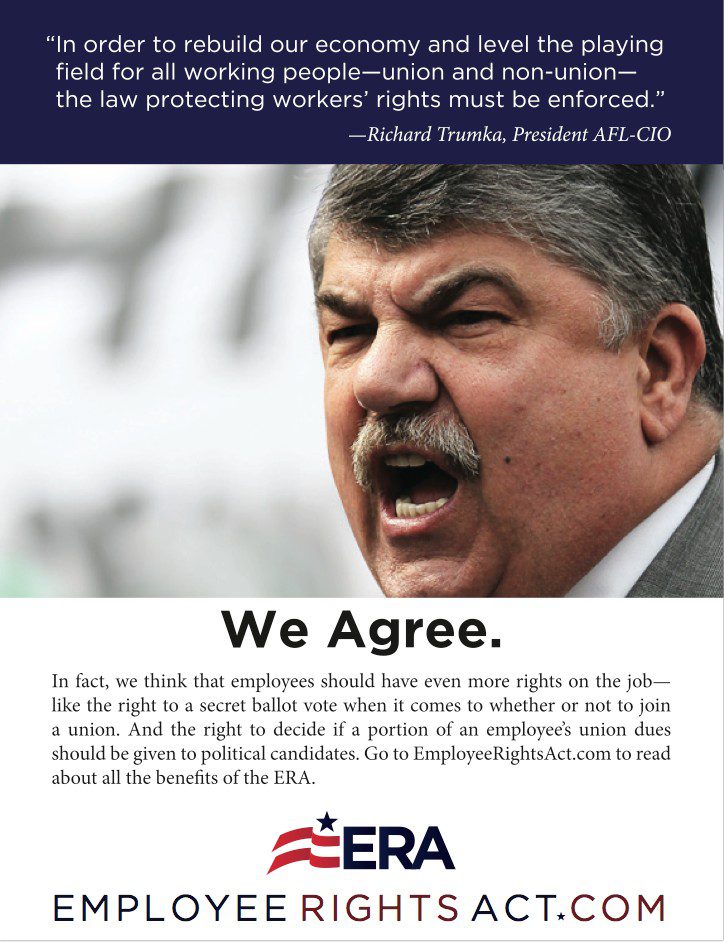
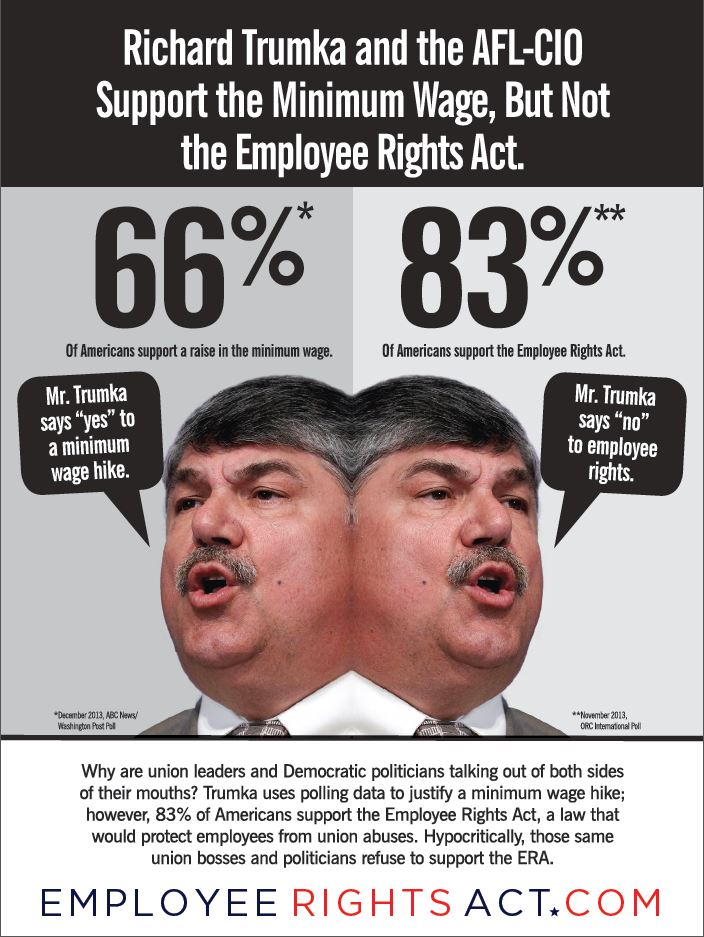
No, this isn’t a setup for a terrible joke. It’s the issue AFL-CIO President Richard Trumka addressed in a recent interview with Reuters. So what are Trumka’s thoughts on the AFL-CIO members that didn’t vote for Obama in 2008?
“Some of this I think was pure racism,” said Trumka. “Some of them would be gun owners, some of them would be right-wing. Some of them would be … dyed-in-the-wool Republicans.”
There’s not a single good reason for any worker, especially any union member, to vote against Barack Obama. And there’s only one really, really bad reason to vote against Barack Obama. And that’s because he’s not white.
According to exit polling by Hart Research in 2008, 30 percent of AFL-CIO members voted for John McCain, and 67 percent voted for Obama.
This is why union bosses want to keep members in the dark when it comes to their rights on paying dues that go to political causes. If paycheck protection was the status quo, how else could Trumka be sure that those who disagree with him get no voice?
The Reuters article also notes that Trumka will spend millions of dollars on the efforts to get Obama reelected and in activating union members in key battleground states.
Trumka does not have the intellectual honesty (or even curiosity) to examine reasons why union members might not want to move in lock-step with union bosses. Instead, he goes for an easy accusation.
In a world with paycheck protection, when 42 percent of union households vote for Republicans–as they did in 2010–labor bosses would have to justify their lopsided spending. In the least, they would have to try to understand why rank-and-file members would vote another way, despite labor efforts and millions of dollars spent.
But it’s those easy justifications—racism, gun nuts, and ingrained ideology—that helps Trumka ignore the rights of union members to speak for themselves. In Trumka’s world, Big Labor knows best, and if you don’t agree, there must be something wrong with you.
If you’re a regular reader of Labor Pains, you might wonder about the credibility of “nonpartisan” studies that talk about how wonderful being in a union can be.
From mid-2004 to 2010, the Economic Policy Institute raised over $9.8 million from labor unions, according the disclosures available from the Department of Labor’s Office of Labor-Management Standards. In 2011 alone, the Economic Policy Institute received over $1.8 million from unions in contributions, gifts and grants, political activities, and representational activities. The donors include the AFL-CIO, UFCW, and the Teamsters.
And have you ever taken a look at their board members? A few people to note:
Richard Trumka (AFL-CIO), Chairman
R. Thomas Buffenbarger (IAMAW)
Larry Cohen (CWA)
Leo W. Gerard (USWA)
Joseph T. Hansen (UFCW)
Mary Kay Henry (SEIU)
Bob King (UAW)
Gerald W. McEntee (AFSCME)
Randi Weingarten (AFT)
And those are just the board members that are literally on the union payroll.
In line with their labor-dominated leadership and donor base, EcPI “studies” come down in favor of bigger government and bigger unions. But their conclusions don’t stand up to closer scrutiny.
In early 2011, for instance, EcPI predicted that spending cuts would cost almost one million jobs. The Wall Street Journal exposed EcPI’s “plug and play economics” that used failed economic “multipliers” to come to the bogus conclusion. As the Journal put it, “Plug in spending and multiplier numbers and, presto, you get the job creation or destruction numbers you need for a political talking point.”
Get connected:
Facebook