Posts Tagged ‘secret ballot’

MSNBC Labor Writer: Union Officials Can Exploit Union Members

Tuesday, April 23rd, 2013

Everyone knows that you have to break a few eggs to make an omelet, but did you also know that union bosses need to exploit a few union members to keep the labor movement strong?

That’s what MSNBC’s labor writer argues in the latest issue of Jacobin (an appropriately-named outlet for such a statement, given the Jacobin connection to the Reign of Terror). MSNBC’s Ned Resnikoff writes:

“Pro-labor sentiment demands that union employees tolerate their own exploitation as a necessary condition of working to free others from exploitation.”

This is a remarkable statement. Usually partisan union activists make the case for labor reform through their actions, rather than their words. As we’ve noted in our previous research, union coercion of employees is astoundingly widespread. In 2010, for instance, unions faced some 6,338 allegations of violating labor law—80.6% of which concerned a union attempting to “restrain or coerce employees in the exercise” of their rights under the National Labor Relations Act.

Now we have a prominent pro-union opinion writer arguing that such coercion and exploitation is sometimes justified—and even laudable.

For our part, we can’t think of a better way to show why the country’s employees desperately need reforms that will empower them while limiting the power of union officials.

That’s why the Employee Rights Act is more necessary than ever.  From the secret ballot to the criminalization of threats of union violence, there are a number of reforms in the ERA that would make the workplace both fair and democratic for all employees. Nowhere is this more needed than in the union hall, where apparently the Golden Rule can be sacrificed for the “Greater Good.”

Baker’s Union Burns Hostess, Teamsters, And Members

Thursday, February 7th, 2013

twinkieThe Hostess Baker’s Union is back and ready to be more destructive than ever. And as details emerge from what happened behind the scenes during the November strike that led to the company’s liquidation, it’s clear that the plans of union officials are never completely baked.

As the first bidders on the bankrupt snack and bread company have begun to pop up, the Bakery, Confectionery, Tobacco Workers and Grain Millers (BCTGM) union is planning to hamstring the buyers before the checks are even signed.

Peter Kaufman of the Gordian Group, the firm representing BCTGM in the bankruptcy, dropped a bombshell on CNBC anchor Brian Sullivan this week. Kaufman said that the union officials wanted to warn buyers that they would consider asking the AFL-CIO to add Hostess products to its boycott list if union members were not rehired.

“That seems aggressive. That seems, in some ways, counterproductive,” said Sullivan. He’s right. And the Dallas Observer’s report on the Hostess disaster tells us that being counterproductive is what BCTGM officials do best.

The Observer tries to tell a story about corporate greed and the people hurt by it. That includes Mike Hummel, who appeared on CNBC with our Managing Director J. Justin Wilson. But later in the story, we learn more about why BCTGM members like Hummel were so convinced that a destructive strike was the best option.

The article reveals that the negotiations were completely mismanaged by BCTGM, starting in 2010. Leaders “sat out most of the talks” with Hostess and the Teamsters. When the time came to consider a new deal, which gave members stock in Hostess, the Teamsters approved it, but the baker’s rejected it. Frank Hurt, then the president of the international, declared “I would never sign this piece of crap.”

But why? The Observer reports:

A source familiar with the negotiations says the bakers union reps had approached a private-equity firm about taking a stake in Hostess. The deal the bakers union bosses proposed could be less painful for their membership, but one of its central tenets was laughably outlandish. For it to work, Hostess would have to eliminate all Teamster drivers from its delivery force. Such a plan, for obvious reasons, wouldn’t fly, couldn’t even get off the ground. Yet it may be one reason why the bakers union leadership was so hostile to the deal on the table — it simply thought it could do better. Or it did, until that prospect fell through. 

So much for brotherhood — the BCTGM was ready to cut out the Teamsters for its own gain. When those officials didn’t get what they wanted, the Observer explains how they led members over the cliff:

Then they virtually assured the bargain all the other parties had worked for would fail. Instead of mailing out ballots to its membership, like the Teamsters had, they held voice votes in their union halls. After all, who wanted to be the guy saying, “Wait up, fellas, let’s think about this for a minute,” after his brothers and sisters next to him had already thundered “Hell no!”?

Yet another reason why the secret ballot provisions of the Employee Rights Act are necessary.

Worse yet, the article also shows how BCTGM officials misled members into thinking that they would eventually have to face a 27 percent pay cut. Meanwhile, the Teamsters and Hostess said that was not the case — and that their salaries would actually be, eventually, restored. Hummel’s confounding argument with Wilson on CNBC finally makes sense. As he told the Dallas Observer, he thought it meant he would lose his house.

So as Hummel and other union members around the country struggle, they’re joined by their brothers and sisters in Minnesota, who are locked out because of the BCTGM’s hardline stance against American Crystal Sugar. 

Who knows what BCTGM officials have in mind, but the best interests of its members are far from it.

NY Times Editors’ Impossible Demands: A More Pro-Union Obama

Tuesday, February 5th, 2013

Yesterday, we found that even a clearly pro-union acting secretary at the Department of Labor (DOL) wasn’t enough to make some members of the American Federation of Government Employees (AFGE) happy. Today, in the alternate universe where the New York Times editors reside, President Obama, too, has not been pro-union enough. The editors write:

What has been missing for years is a forceful labor agenda — one that calls for more jobs, but also has as its goal rising wages coupled with robust hiring.

Mr. Obama can take an important step in that direction by placing his next labor secretary at the center of his economic team. The first-term labor secretary, Hilda Solis, was largely sidelined, a reflection of the administration’s focus on the recovery of Wall Street, not Main Street. Some of the names that have been floated for the job — including Jennifer Granholm, the former governor of Michigan — show that Mr. Obama is seeking someone of high stature, but any secretary’s ability to be a transformative force will depend on the president’s support.

What else would the editors need to see to prove that Obama has a “forceful labor agenda?”  It’s true, as the editors later say, that the Employee Free Choice Act (EFCA) failed miserably in Obama’s first term. But their chief complaint is that Obama wasn’t loud enough about it, with only “scant use of the bully pulpit” in promoting the decimation of employee rights. But the Times board forgets that even when Obama employed it in Michigan, it still didn’t rescue Big Labor from the labor reform movement.

And Solis was no slouch, either. She called herself the “loyal servant” to unions. She changed the rules to favor labor by reducing their reporting requirements and expanding the disclosures for businesses—so much so that proposed regulations will require attorneys to break confidentiality rules.

Obama’s unconstitutional “recess” appointments to the National Labor Relations Board (NLRB) cannot be overstated as a key element to his union agenda. The President was willing to put his executive power on the line just to give organized labor a leg-up at the NLRB, even if that meant choosing a member who has been accused of covering up embezzlement.

Just like the New York City bus drivers union, which is making demands that cannot legally be met, the New York Times editors are asking for the impossible. 

Look for our Super Bowl Ad: Time To Flush Labor Union Intimidation

Sunday, February 3rd, 2013

ToiletLabor unions long to end the secret ballot. The Employee Rights Act (ERA) would sack them before that bad idea gets out of the pocket. The ERA guarantees employees’ right to a secret ballot vote.

That’s because voting — like some other things — should be done in private. Super Bowl viewers will learn more about that on Sunday when they see the latest ad from the Center for Union Facts. Take a look:

Organized labor would rather have one of its organizers looking over an employee’s shoulder when he or she votes. We often hear about the intimidation and confusion that results from a “card check” unionization campaign, and this problem is repeated over and over again every day.

The ERA ensures that a secret ballot will be taken when employees decide whether or not they want to join a union and in other labor actions, including strike votes. And union households overwhelmingly support the principles of the ERA.So when you’re watching the game on Sunday, be ready to talk to your friends about the Employee Rights Act and how organized labor wants to invade your private time.

Labor’s Hatred of Democracy In Action

Friday, January 11th, 2013

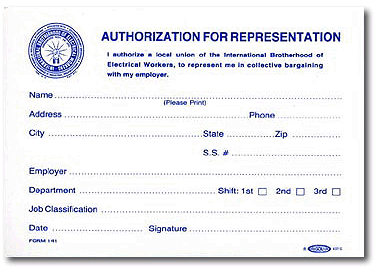
IBEW CardAs members of Congress, state legislatures, and the President of the United States are sworn into office, we’re reminded of our American democratic ideals. Unfortunately, many union members don’t get the chance to celebrate democracy thanks to a unionization procedure known as “card check.”

Take Karen Cox and her coworkers at Americold Logistics, who are only the latest examples of how unions intend to end the secret ballot in labor organizing. In spring of 2012, she was given a card that she was told would be used for information purposes. She filled it out and returned it. But in June, she learned that she, along with at least 50 percent of her fellow coworkers, had signed and returned the cards that recognized a labor union.

Cox, who opposed the union, tried to collect petitions from co-workers to call for a secret ballot vote. But rather than let her have the same access rights as union organizers, Cox was stopped from doing so by Americold. She’s now being represented by National Right to Work Foundation in a complaint against the company filed with the National Labor Relations Board (NLRB).

“I think they did it that way as a way for the union to sneak in without opposition,” Cox told Sauk Valley Media. “Some people were mad about that, and all I want is a legit election.”

In 2011, Barbara Ivey shared her very similar story. A 21-year employee at Kaiser Permanente in Oregon, she was shocked that after only 13 days, a Service Employees International Union (SEIU) card check campaign successfully turned her workplace into a union shop. Ivey said that her coworkers felt pressure to sign the card.

CardCheckIvey began to collect signatures for a decertification election, which would allow the employees to vote on the unionization by secret ballot. Although these elections used to take place immediately after a card-check drive, a “safety valve” provision to ensure the card check collection was proper, the NLRB’s penchant for overturning precedent ended that protection. In Lamons Gasket, the NLRB did away with the immediate vote petition and instead required that more time elapse before the decertification vote could take place.

These women aren’t outliers. In fact, denying the secret ballot vote is policy for labor. That didn’t die with the EFCA. With UNITE HERE leading the way, several labor groups, notably the AFL-CIO, backed a boycott of Hyatt Hotels in July because the company refused to allow card check unionization at its hotels.

Just prior to the November election, Richard Trumka of the AFL-CIO told the Atlantic that labor will never give up on card check. “That’s within the next term,” he claimed.

Card check is no way to determine if an individual really wants to join a union. The process is fraught with potential problems—deception and intimidation chief among them, as shown in the workplaces of Cox and Ivey. Card check makes the vote public and puts employees in the difficult position of openly stating their position to a union organizer. The Employee Rights Act requires secret ballot elections for union certification votes in order to ensure that each individual employee can decide whether she wants to join a union without someone looking over her shoulder.

Who’s watching the watchmen?

Wednesday, August 8th, 2012

Yale Political Science Professor Jacob Hacker and Yale law student Nate Loewentheil seem to have solved America’s woes in a mere 58 pages, Intro to Conclusion, with their plan for “Prosperity Economics.” It strikes common left-leaning themes:  government control is better than free markets; spending is a good thing; inequality finds no respite in social mobility, etc.

The notable supporters of the plan are the AFL-CIOSEIU, and the Big Labor-funded Economic Policy Institute. The report was released at EcPI and included remarks from Richard Trumka of the AFL-CIO.

The group Loewentheil founded, The Roosevelt Institute, received a total of $35,000 from the AFL-CIO, UNITE HERE, and the Teamsters in July and August of 2011. And the website for the report directs the “Contact Us” email address to Jeff Parcher of the Center for Community Change, another supporter of the plan. The Center and its sister organization, the Campaign for Community Change, received a combined $35,000 from the SEIU National Headquarters and a local chapter, AFL-CIO, and UNITE HERE in 2010-2011.

So how do we get to the promised land? With more unions, of course!

Two sets of checks and balances within the market are particularly important: improved corporate governance and unions.

***

Empowering unions and other forms of collective bargaining is therefore a top priority… To that end, we must implement a quick, fair process for workers to choose union representation and have the power to bargain collectively and stronger penalties for violation of labor laws. (emphasis in original).

The report goes on to discuss the ills of political money in elections, highlighting that corporations can spend money with Super PACs. Not surprisingly, the report fails to mention that unions can do the same thing. Although “evil corporations” make for great boogeymen in the campaign finance world, it’s disingenuous to claim that your opponents’ exercising their rights is wrong when you also take advantage of the same laws.

It’s possible we missed the press release about how the SEIU was no longer supporting pro-Obama Super PACs or coordinating its advertising with a Super PAC supporting Democrats running for the House of Representatives. Or perhaps we didn’t hear Richard Trumka say that he’s dropping the Super PAC the AFL-CIO started last year. But that’s doubtful.

And while Hacker and Loewentheil discuss why democracy is so important, they leave out the glaring problem with entrusting unions as the watchmen. Unions can often be established and remain in power without a secret ballot vote, or even without a vote at all.

The only good explanation for this omission is that union bosses are on the side of the angels. And if you don’t agree with them, it doesn’t quite make you the devil—it only makes you either a racist, a gun nut, a right-wing kook, or, worst of all, a Republican.

Votes for Some

Monday, June 25th, 2012

The Communication Workers of America (CWA) is in an ongoing dispute with bankrupt American Airlines over an attempt to unionize the struggling carrier’s passenger service agents. Under National Mediation Board (NMB) rules—as an air carrier, American’s labor rules are set by the Railway Labor Act — 50 percent of the agents must sign a statement of interest before an election can be held.

Before February, that threshold was 35 percent. Since the CWA started its campaign before the law changed, it argued that it only needed to meet that threshold, but a federal judge disagreed. From the Associated Press:

Judge [Terry R.] Means, who oversaw a brief trial in his Fort Worth, Texas, courtroom this month, ruled that the 50-percent standard applied by the time that the mediation board got around to reviewing the union’s election request in April. He issued an injunction barring the board from conducting any further election-related activities.

Needless to say, the CWA is displeased. And to garner support, the union is promoting this advertisement:


Of course, the CWA didn’t always think that “stopping workers from voting is UnAmerican.” Back in 2009, the CWA and its parent, the AFL-CIO, endorsed and pushed hard for the so-called “Employee Free Choice Act,” which would have curtailed employees’ right to vote on whether to unionize. Now that the shoe is on the other foot, the CWA has backed voting.


SEIU Takes “Out of Context” to a Whole New Level

Friday, March 20th, 2009

Misleading commentary from the SEIU is nothing new, but a post on their blog today is truly astounding. In a laughable attempt to claim that EFCA will preserve workers’ right to a secret ballot, they quote today’s Wall Street Journal editorial, saying:

“The bill doesn’t remove the secret-ballot option from the National Labor Relations Act…”

Hmm… Here’s that sentence again, without the SEIU’s editing:

“The bill doesn’t remove the secret-ballot option from the National Labor Relations Act but in practice makes it a dead letter.

Notice a difference? I thought so. The fact that the unions are still clinging to the 30-50 myth is a reflection of their casual relationship with the truth. In case you’re still not sure EFCA ends elections, just read the bill itself:

If the Board finds that a majority of the employees in a unit appropriate for bargaining has signed valid authorizations designating the individual or labor organization specified in the petition as their bargaining representative and that no other individual or labor organization is currently certified or recognized as the exclusive representative of any of the employees in the unit, the Board shall not direct an election but shall certify the individual or labor organization as the representative described in subsection (a). [emphasis added]