
Summer 2023 was hailed as the “Summer of Strikes” as major labor unions across the country threatened or conducted work stoppages to a flurry of media attention. Signs pointed toward a revitalized labor movement ready to reverse the decades-long trend of dwindling union membership.
Two years later, these same unions are facing a massive reality check.
A recent study conducted by Bloomberg Law found that union-negotiated wage gains peaked in 2023, and have been declining ever since. The average union-negotiated wage gain has fallen by approximately 33 percent since its peak at the end of 2023, and is trending towards the pre-pandemic average.
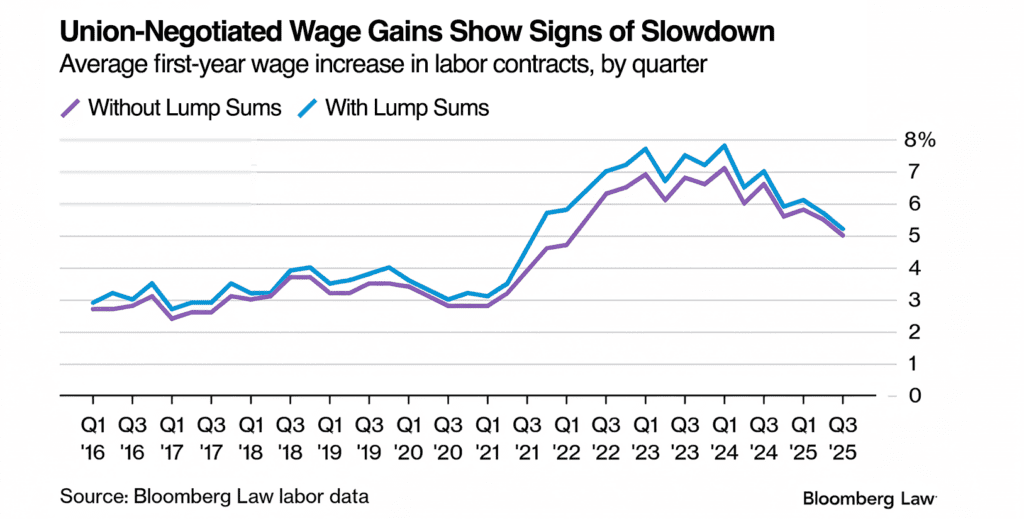
A close look at what the top unions have been up to in the last two years may explain why high hopes for a labor resurgence have fallen flat.
Consider the United Auto Workers (UAW), which launched one of the most prominent strikes when workers walked off the job in September 2023. The union won what it called “record” contracts with Detroit’s “Big Three” automakers after a 45-day strike and immediately announced plans to unionize some 150,000 non-union autoworkers across the United States.
This hasn’t panned out. The UAW managed to get one plant in Tennessee to join the UAW in early 2024 but was then walloped in unionization votes at Mercedes and Navistar. The union hasn’t announced progress with any other automakers since, and has been buffeted by layoffs and internal strife. Tens of thousands of UAW members have been laid off since 2023, and the union was recently forced to remove its chief of staff after he allegedly retaliated against one of the UAW’s officers.
But the UAW isn’t the only 2023 darling that’s fallen from grace.
The International Brotherhood of Teamsters earned a lot of attention by forcing a new, expensive contract with the United Parcel Service (UPS) after an initial strike threat. Now, members are reaping the consequences. UPS recently cut 48,000 jobs and closed 93 facilities. The company also eliminated several thousand Teamsters jobs via a buyout program.
Additionally, courts recently revived a lawsuit against the Teamsters over a different 2023 strike threat. The lawsuit could put the Teamsters on the hook for nine-figure total in damages for allegedly driving Yellow Trucking out of business in the heat of the summer of strikes. The fights with UPS and Yellow brought Teamsters President Sean O’Brien a lot of attention in 2023, but their aftershocks are still dogging the union’s members.
Last but not least, there’s Starbucks Workers United (SWU). The barista union had a breakout year in 2023 and made headlines by staging a huge walk-out on Starbucks’s annual Red Cup Day. Two years later and the movement shows signs of running out of steam.
SWU grew from a single shop to 9,000 members between 2021 and 2023, but has only grown to about 12,000 members since then. In other words: the union’s rate of growth has declined by 66% since 2023. Right now, that translates into fewer than 4% of Starbucks employees working in coffeehouses represented by SWU.
SWU still doesn’t have a contract with Starbucks, leading the union to launch additional strikes – including its most recent “Red Cup Rebellion.” The union held strikes and encouraged the public to boycott Starbucks. Despite these efforts, the company reportedly saw one of its best sales days ever on Red Cup Day 2025. In fact, Starbucks reported that the strike only impacted one percent of its stores.
High on the fleeting success of the “Summer of Strikes,” it seems these major unions flew too close to the sun. This burnout has paved the way for a real winter of woes. Unfortunately for union members, this turning tide will likely last for more than just a season.