Archive for the ‘AFSCME’ Category

Wisconsin-esque Bills Flooding Legislatures Nationwide

Friday, April 8th, 2011
Photo credit: David Greg Katechis

Photo credit: David Greg Katechis

Since the governors of Wisconsin and Ohio put an end to doing business-as-usual with public-sector unions, nearly 750 bills have been introduced by fiscally responsible legislators (or at least those trying to be) in almost every state. Most reports suggest the obvious: that this is a bad thing for unions and their lockstep members, of course.

The Los Angeles Times is by no means a cheerleader for these predominantly Republican state legislators, but the Times did manage to mention a few noteworthy facts on their behalf (via information it gathered, in part, from the National Conference of State Legislatures):

  • Nearly half of states are considering legislation to limit public employees’ collective bargaining rights.
  • A number of states are considering bills that would limit unions’ ability to collect dues from public employees.
  • Other bills would eliminate a requirement that workers covered by union contracts pay union dues or fees.
  • [P]roposals to roll back pensions are gaining steam.

We wouldn’t say that the days of public officials and workers being bullied into submission by union leaders are coming to an end, but the tide may just turning in favor of the taxpayers who’ve been footing the bill.

Wisc. Union to Small Businesses: Support Us or We’ll Boycott

Monday, April 4th, 2011

Small business owners in southeast Wisconsin have been given an ultimatum by a local public sector labor union: Proudly display our pro-union sign in your storefront windows or we’ll boycott.

“Failure to do so will leave us no choice but (to) do a public boycott of your business,” states a letter to businesses from the Wisconsin State Employees Union, AFSCME Council 24. “And sorry, neutral means ‘no’ to those who work for the largest employer in the area and are union members.”

Reluctant business owners say they prefer to remain neutral in a battle that should be settled in the Capitol and not on Main Street. Rev. Jesse Jackson defended the union’s boycott effort to the Milwaukee Journal Sentinel stating that it’s merely a “nonviolent tactic used to get attention to the steamroller tactics” of Wisconsin Republicans and Gov. Walker.

Call these anti-small business threats “non-violent” all you want. That doesn’t mean they won’t do a lot of damage to innocent bystanders if and when the union follows through.

Some Good News From the States

Wednesday, December 29th, 2010

Last week we discussed the dire situation of several states’ pension funds. But while many states are headed for stormy waters, today brought two very positive developments that indicate labor unions’ stranglehold on state governments may be loosening.

First from Pennsylvania:

Three of the largest state employee unions wanted to remove one of the more pressing issues that Gov.-elect Tom Corbett will find on his doorstep when he walks into office on Jan. 18. They sought a one-year extension to their labor contracts that expire June 30.

Leaders of the American Federation of State, County and Municipal Employees Council 13, Pennsylvania Social Services Union Local 668 and United Food and Commercial Workers approached outgoing Gov. Ed Rendell as well as members of Corbett’s transition team about the idea.

While Rendell saw advantages for his successor to not have to deal with labor negotiations right off the bat as he did when he first was elected in 2003, the incoming governor showed no interest when the two discussed the matter last week.

This was a desperate attempt by the unions to head off Corbett, who has promised to cut state spending and not raise taxes. Corbett, a fiscal conservative, will be far more likely to crack down on organized labor than Rendell. Thus the unions need Rendell to solve their problems — and quickly. Kudos to him for turning them down.

Meanwhile Indiana may join the ranks of right-to-work states:

Republicans in the Indiana House have filed bills that would prevent workers from being required to pay union dues, an issue considered so divisive that Gov. Mitch Daniels would prefer to avoid it.

The so-called right-to-work legislation could move forward anyway since Republicans have full control of the General Assembly after winning a House majority in last month’s election. The bills would prohibit companies from making union dues or membership a requirement of employment.

Daniels is understandably nervous about spending lots of political capital on what’s sure to be an acrimonious battle against the unions. (One Indiana Democrat is already claiming that right-to-work laws discriminate against women and minorities.) If the bill does pass, it would make Indiana the 23rd right-to-work state.

Image courtesy of tricky ™.

Refuting the Union Spin on Public Employee Pensions

Wednesday, December 22nd, 2010

It’s being called a “one-sided report” by the AFSCME. The AFL-CIO says it “could have been written by anti-worker, anti-union New Jersey Gov. Chris Christie.” As far as we’re concerned, those are fantastic reviews. The report in question is a 60 Minutes piece from Sunday that broke through the union spin and told the truth about how public-sector unions are helping bankrupt states across the nation via pensions plans and more.

The video is a little long, but a must-see. Click here to watch.

The AFL-CIO links to a blog post by left-wing watchdog Media Matters that attacks 60 Minutes for never mentioning the words “tax cuts” in regards to New Jersey’s pension woes. (Because we all know what a low-tax haven New Jersey is.) The post quotes a New York Times article mentioning that tax cuts enacted in New Jersey in 1995 diverted money from the state pension fund.

But as is also stated in the Times article, New Jersey more recently raised pension benefits 9 percent and lowered the retirement age to 55. These giveaways were so absurd that the Securities and Exchange Commission later charged New Jersey with fraud for falsely claiming it had the resources to fund its generous pensions. (Pensions were later curbed a bit when it became evident a crisis was looming.) Oddly, these details never made it into the Media Matters report.

Also overlooked by the left: New Jersey has the highest tax burden in the nation. And yet the state’s pension system was so unsustainable that even those tax rates couldn’t prop it up. New Jersey’s pension system is underfunded by more than $170 billion, or 44 percent of New Jersey’s gross state product, according to the Mercatus Center. How exactly are state taxes supposed to fill such a massive gap?

Media Matters concludes by accusing 60 Minutes of having a “conservative framing.” But there’s nothing conservative about it. The fact is that the pro-union, big-government position on pensions is such blatant political spin that it’s not worth reporting.

Image courtesy of joiseyshowaa.

It’s being called a “one-sided report” by the AFSCME. The AFL-CIO says it “could have been written by anti-worker, anti-union New Jersey Gov. Chris Christie.” As far as we’re concerned, those are fantastic reviews. The report in question is a 60 Minutes piece from Sunday that broke through the union spin and told the truth about how public-sector unions are helping bankrupt states across the nation via pensions plans and more.

The AFL-CIO links to a blog post by left-wing watchdog Media Matters that attacks 60 Minutes for never mentioning the words “tax cuts” in regards to New Jersey’s pension woes. (Because we all know what a low-tax haven New Jersey is.) The post quotes a New York Times article mentioning that tax cuts enacted in New Jersey in 1995 diverted money from the state pension fund.

But as is also stated in the Times article, New Jersey more recently raised pension benefits 9 percent and lowered the retirement age to 55. These giveaways were so absurd that the Securities and Exchange Commission later charged New Jersey with fraud for falsely claiming it had the resources to fund its generous pensions. Oddly, these details never made it into the Media Matters report.

Also left out of the left’s assessment: New Jersey has the highest tax burden in the nation. And yet the state’s pension system was so unsustainable that even those tax rates couldn’t prop it up. New Jersey’s pension system is underfunded by more than $170 billion, or 44 percent of New Jersey’s gross state product, according to the Mercatus Center. How exactly are state taxes supposed to fill such a massive gap?

Media Matters concludes by accusing 60 Minutes of having a “conservative framing.” But there’s nothing conservative about it. The fact is that the pro-union, big-government position on pensions is such blatant political spin that it’s not worth reporting.

Union leaders try to spin away election results

Wednesday, November 3rd, 2010

Democrats took a severe beating last night, losing over 60 seats in the House of Representatives, and at least six Senate seats. Republicans also had momentous pick-ups among governors and state legislatures. Exit pollsters found that voters thought the government was too big and that they disliked Barack Obama’s agenda.

The results are very bad news for the country’s labor unions. Organized labor broke the bank this election season trying to stem the Republican tide. The American Federation of State, County, and Municipal Employees (AFSCME), the largest public-sector union in the country, spent an astonishing $87.5 million to get Democrats elected, the biggest contribution in the race. The Service Employees International Union (SEIU) donated another $44 million.

It made very little difference. Now comes the day after. Just how will America’s most lovable labor leaders try to rationalize their way out of this one? Some did better than others.

AFL-CIO President Richard Trumka:

“We did our job. No matter what demographic, you look at our membership, we had large margins for progressive candidates approaching 30, with Harry Reid it was higher. … I think [Democrats] are cognizant of what we did and if they aren’t they should pay heed to it.”

In other words, don’t blame us…or else.

SEIU President Mary Kay Henry:

“[W]e are looking to the new leaders elected tonight to show up in January ready to work for the American people — not for the agenda of the nameless, faceless corporations who poured hundreds of millions of dollars into our political process.”

I.e. please ignore the millions we pumped into campaigns.

United Food and Commercial Workers President Joe Hansen:

“In stark contrast to 2008, the election of 2010 will be remembered because the results were fueled not by hope, but by anger, frustration, and fear. … Empty and inflammatory rhetoric that derides health reform as ‘Obamacare’ and demonizes leaders as socialists will not right the imbalance in our economy or help working people make ends meet.”

In other words, we’re angry that you’re angry.

National Education Association President Dennis Van Roekel:

“NEA stands ready to work with the new Congress to put students first and ensure that education is the engine that moves America forward. We will work with all policymakers to maximize the achievement, skills, opportunities and potential of all students, to make sure they are prepared to become creative and productive citizens in our democratic society and diverse world.”

Because the NEA is all about students, not teachers.

AFSCME President Gerald W. McEntee:

“The loss of the U.S. House of Representatives is a real setback for working families. Washington Republicans have done nothing since the last election to curtail the Bush recession and bring down unemployment.”

It’s also a real setback for our wallets, which are feeling pretty empty this morning.

Whatever stages of grieving union leaders are at, soon the reality will set in.  With a Republican-controlled House, labor legislation will get very little traction over the next two years.

The hand that feeds you: Public-sector unions dominate campaign finance

Friday, October 22nd, 2010

The next time you see an advertisement for a pro-union Democrat, keep in mind where some of the money is coming from: the American Federation of State, County, and Municipal Employees.

The 1.6 million-member AFSCME is spending a total of $87.5 million on the elections after tapping into a $16 million emergency account to help fortify the Democrats’ hold on Congress. Last week, AFSCME dug deeper, taking out a $2 million loan to fund its push. The group is spending money on television advertisements, phone calls, campaign mailings and other political efforts, helped by a Supreme Court decision that loosened restrictions on campaign spending.

“We’re the big dog,” said Larry Scanlon, the head of AFSCME’s political operations. “But we don’t like to brag.”

The 2010 election could be pivotal for public-sector unions, whose clout helped shield members from the worst of the economic downturn. In the 2009 stimulus and other legislation, Democratic lawmakers sent more than $160 billion in federal cash to states, aimed in large part at preventing public-sector layoffs. If Republicans running under the banner of limited government win in November, they aren’t likely to support extending such aid to states.

As the Center for Union Fact’s Sonny Bunch noted about teachers unions, a majority of public-sector employees probably vote Democrat. But 100% of public-sector employees do not. And yet the AFSCME’s members are forced to watch their dues bankroll a last-ditch blitz to save the Democrats’ congressional majorities.

According to Chris Edwards of the Cato Institute, the compensation difference between a state that has no public sector union representation and one that has the average number of government employees unionized is 8.1%. And James Sherk of the Heritage Foundation calculates that “Salaries and benefits – for identical jobs – are 30 percent to 40 percent higher in the federal government than in the private sector.”

Now the public is catching on. A recent Washington Post poll found that 52 percent of Americans think government employees are overpaid. Three-quarters believe that government workers make more than those in the private sector. And lawmakers like New Jersey’s Chris Christie have taken on public-sector unions and won.

When Bystanders Become Collateral: NLRB rules in favor of letting unions intimidate neutral businesses

Thursday, October 21st, 2010

Labor unions are allowed to “pressure” businesses with which they have a direct dispute. But what about companies that are completely neutral? Keith Eastland, a labor lawyer in Grand Rapids, wrote an op-ed explaining an unfortunate decision by the National Labor Relations Board.

Employers can expect the new board to grant much broader protections to union-related activity. An Aug. 27 board decision on “bannering” highlights this point. Bannering refers to the display of large signs, often containing misleading claims, at job sites belonging to neutral parties. It is a union tactic often designed to threaten and coerce neutral businesses to avoid dealing with non-union contractors or suppliers.

Although the law expressly prohibits unions from engaging in coercive or threatening actions toward neutral businesses, the new board has ruled that bannering is protected. Under this new rule, unions can now target your business or job sites with large banners — or use giant inflatable rats signifying the presence of “scabs” — even when you have no labor dispute with that union.

The case before the NLRB began in Arizona where representatives of the Carpenters Local 1506 (consisting of non-union temp workers  being paid to play the part of “picketer”) held 16-foot-long signs outside two medical centers and a restaurant. The signs read “Shame on…(the name of the establishment)” with the words “Labor Dispute” nearby. The catch? The establishments had no conflict with the union. The dispute was with construction companies doing work for the establishments’ owners.

This should have been a no-brainer for the NLRB. The National Labor Relations Act forbids conduct found to “threaten, coerce, or restrain” secondary businesses not involved in the primary dispute. But chalk one up to the labor-stacked NLRB, i.e. Craig Becker and Co.: They found a way to rule in the union’s favor.

To what extreme’s will unions take this new rule?

Recently the [United Brotherhood of Carpenters in Salt Lake City] has taken its bannering a step further by targeting companies that don’t do business with the Contractors. The banners are the same. But the handbills reveal that the company named is a potential tenant in a building where one of the Contractors is slated to perform work. According to the Union, the company being bannered is guilty of “thinking about profiting from unfair labor practices.” By this measure, most of the population might be subject to bannering.

A “potential tenant” where a company “is slated to perform work”? How far will bannering go? Could a union pressure the company that employs the aunt of the owner of a plumbing company that services an office building that houses a paper company that sells supplies to another company with which the union has a dispute? Or perhaps just thinking about selling supplies is enough to put a company in the unions crosshairs. Thanks to Craig Becker’s NLRB, it’s certainly possible.

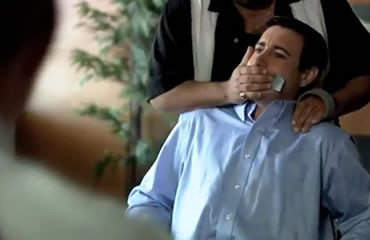
This video drives home the point. Despite being about NFCW, not the Carpenters, it’s the same practice of creating a deceptive union picket line.

The Daily Show With Jon Stewart Mon – Thurs 11p / 10c
Working Stiffed
www.thedailyshow.com
Daily Show Full Episodes Political Humor Rally to Restore Sanity

Obama to AFL-CIO: There’s more than one way to skin a cat

Friday, August 6th, 2010

There have been several times when I’ve discussed the alternate means of implementing some of the key tenets of the Employee Free Choice Act, like HERE and HERE. It’s just nice to have the President blatantly confirm this agenda in his speech to the AFL-CIO.  Basic story? EFCA will be a challenge in the lame duck session, but no worries, we’ve got other ways of making it happen. From the Wall Street Journal:

Mr. Obama reiterated that the administration will put its weight behind it. “We are going to keep on fighting to pass the Employee Free Choice Act,” he told the 54 executive council members and others in the room. “We also know what and who is standing in the way of progress,” he said, adding that it will be “tough” to get the bill through the Senate and will take time to reverse the impact of “at least eight years in which there was a profound animosity toward the notion of unions.”

Mr. Obama also reminded the labor officials of the ways in which the administration has already supported unions, in part by wielding executive powers for actions that don’t require legislation.

“There’s a reason why we nominated people to the National Mediation Board that would ensure that folks in the rail and air” industries can organize, said Mr. Obama, referring to the board’s overhaul in May of a decades-old rule that had made it harder for airline and railway workers to unionize. He also cited the Democrats he nominated to the National Labor Relations Board to “restore some balance” to the group, which supervises union elections and referees disputes between private-sector employers and employees.